
Educational areas
Robotics
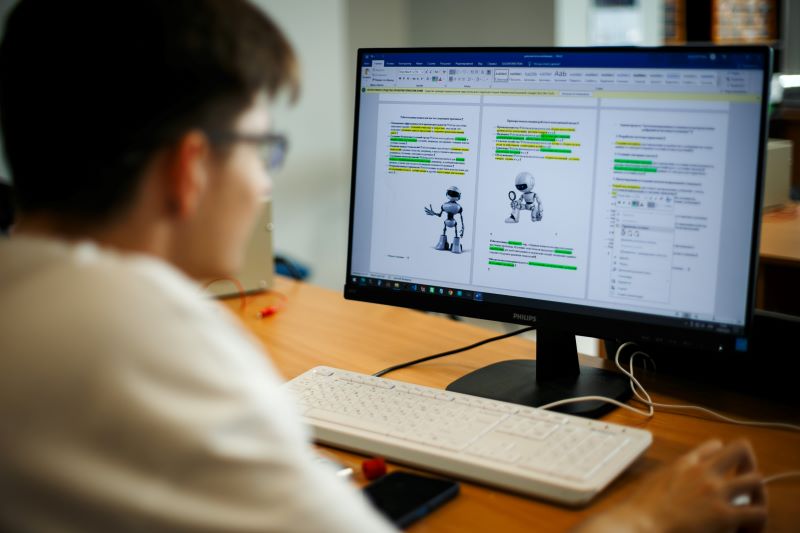 Robotics is a set of mechanisms and devices (software control devices, their working parts (gripping devices and tools), external auxiliary axes, sensors, communication interfaces, electronic and other devices), the core of which is modern high-speed and software-hardware computing tools that form a unified automated production system capable of performing various work and technological operations (welding, spatial movement, product assembly, packaging, painting, machining, and others).
Robotics system is any system containing at least one industrial robot. A robotics system can be a single industrial robot as an independent object of development, a robotics complex, or a flexible production system (section, line).
The Robotics Systems program includes:
- studying the structure of AVR microcontrollers and the criteria for configuring the controller’s hardware units;
- familiarization with programming languages and systems for industrial robots;
- acquiring the skills to solve typical problems in electronics and circuit design;
- formation and development of skills and abilities in the design and construction of housing parts and mechanical assemblies;
- development of skills in SolidWorks, Proteus, and CodeVisionAVR software environments;
- mastering the skills of programming AVR microcontrollers in the C programming language;
- acquisition of the skills and abilities necessary to create
3D models of the devices under development and drawings.
Curators of the program:
Prokhorovich Sergey Sergeevich – Senior Lecturer at the Department of Robotics Systems at the Belarusian National Technical University;
Matrunchik Yulia Nikolaevna – Senior Lecturer at the Department of Robotics Systems at the Belarusian National Technical University;
Marchenko Ivan Sergeevich – Assistant of the Department of Robotics Systems at the Belarusian National Technical University;
Ocheretny Alexey Maksimovich – Head of the Laboratory of Robotics of the National Children’s Technopark Educational Institution, Master.
Mechatronics is a synergistic interaction of mechanical engineering, electrical engineering, and information technology disciplines in the design and production of industrial products, as well as in the design of technological processes.
The Industrial Mechatronics and Robotics program includes:
- studying the structure of Siemens and CodeSys programmable logic controllers and LOGO! programmable relays;
- familiarization with the internal structure of industrial robot mechanics and electronics;
- acquiring skills in solving typical problems in pneumatics and electrical engineering;
- formation and development of skills and abilities in the design and construction of conveyors, accumulators, dispensers, etc.;
- development of skills in SolidWorks,
TIA Portal, and FluidSim software environments; - mastering the skills of programming programmable logic controllers using IEC 61131-3 programming languages (LD, FBD, SFC, ST, IL);
- acquisition of the skills and abilities necessary to create
3D models of the devices under development and drawings.
Curators of the program:
Marchenko Ivan Sergeevich – Assistant of the Department of Robotics Systems at the Belarusian National Technical University;
Matrunchik Yulia Nikolaevna – Senior Lecturer at the Department of Robotics Systems at the Belarusian National Technical University;
Gagakov Yuri Vitalievich – Head of the Automated Production Management Systems Group at Alyutech Incorporated;
Ocheretny Alexey Maksimovich – Head of the Robotics Laboratory at the National Children’s Technopark Educational Institution, Master’s Degree;
Blagodarov Kirill Evgenievich – engineer for setup and testing at Technikon LLC.
The programs are implemented with the assistance of the Belarusian National Technical University.
Computer Vision in Automated Devices is a field that studies machine vision technologies and their application in intelligent and embedded systems.
The Computer Vision in Automated Devices program includes:
- familiarization with image and video processing methods for automated systems;
- practical application of ready-made frameworks and trained neural networks for analyzing visual information;
- development of programs for controlling cameras, sensors, and actuators;
- studying the methods of interaction between devices that ensure the operation of autonomous systems;
- learning Python and C++ programming languages to create intelligent solutions with computer vision elements;
- mastering the OpenCV machine vision library;
- design and construction of automated systems that can adapt to environmental changes;
- The practical application of computer vision technologies in various fields, from personal gadgets and cameras to home and service robots.
Curators of the program:
Pavel Dmitrievich Kostenok – Information and Communication Technologies Engineer at KonstantTime LLC;
Kiselev Vitaly Vladimirovich – Electronic Engineer at Mozyr Oil Refinery OJSC;
Prokhorovich Sergey Sergeevich – Senior Lecturer at the Department of Robotics Systems at the Belarusian National Technical University;
Marchenko Ivan Sergeevich – Assistant of the Department of Robotics Systems at the Belarusian National Technical University;
Ocheredny Alexey Maksimovich – Head of the Robotics Laboratory of the National Children’s Technopark Educational Institution, Master;
Matrunchik Yulia Nikolaevna – senior lecturer at the Department of Robotics Systems at the Belarusian National Technical University.
The program is implemented with the assistance of ConstantaTime LLC andBelarusian National Technical University.
Intelligent humanoid robots are anthropomorphic mechanisms equipped with artificial intelligence elements that reproduce the human anatomical structure, are able to adapt to the environment, and use machine learning technologies to make decisions and improve their skills.
The Intelligent Humanoid Robots program includes:
- introduction tothe basics of humanoid robotics based on the Unitree G1\Unitree Go2 training platform (hereinafter referred to as intelligent humanoid robots);
- introduction to basic control functions for intelligent humanoid robots;
- study of safety principles when working with this type of robot;
- formation of knowledge about the devicesof the humanoid robot‑and the dog robot: drives, sensors, on-board computers;
- development of skillsinя и диагностикconnecting diagnostics and peripherals (calibration and initial configuration of platforms);
- formation and development of skills in designing and developing intelligent software for the class of two-legged and four-legged robots;
- development of skills in the ROS 2 management software framework;
- mastering programming skills in the Unitree SDK: APIs, data exchange protocols;
- learning algorithms for intelligent motion control: walking, turning, and overcoming obstacles.
- рdevelop skills in programming behavioral scenarios..
Curators of the program:
Vladimir Adamovich Golovko – Head of the Departmentой of Technical andIntellectualх Informationх Technologies of the educational institution “Brest State Technical University”, Doctor of Technical Sciences, Professor;
Kasyanik Valery Viktorovich – Senior lecturer of the Department of Intelligent Information Technologies, Head of the Laboratory “Industrial Robotics” of the educational institution “Brest State Technical University”;
Sergey Selivonchik– Director of Industrial Automation Systems LLC.
Programsa are implemented with the assistance of Brest StateTechnical University.






 Minsk, Franziska Skaryna street, 25 k 3