
Educational areas
Information and computer technologies
Prototyping
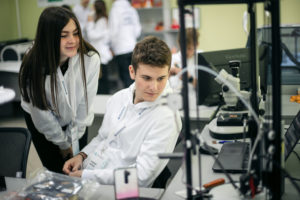
Программа «Прототипирование» предполагает:
Prototyping is widely used in mechanical engineering, instrumentation, programming, and many other fields of technology. Prototyping is the ability to create a prototype (trial model) of a product, product components, or individual parts in full size using digital manufacturing technologies in a short amount of time.
The «Prototyping» program includes:
- familiarization with the basics of technical drawing and working in the Autodesk 3ds Max and Fusion 360 3D modeling systems;
- learning the technology of designing and building 3D models, as well as importing 3D models in various formats and using them to build your own designs;
- mastering the principles of a 3D printer;
- creation, cloning, and transformation of 3D objects;
- creation of complex three-dimensional models and simulations of physical phenomena to confirm the feasibility of the created structures.
Curators of the program:
Gordeuk Anastasia Vladimirovna – teacher of the highest category of the cyclical commission of software of information technologies of the educational institution «Belarusian State University of Informatics and Radioelectronics», branch «Minsk Radio Engineering College»;
Irina Aleksandrovna Sereda – Senior Lecturer of the Department of Information Systems and Technologies of the separate unit «Institute of Information Technologies of BSUIR» of the Educational Institution «Belarusian State University of Informatics and Radioelectronics», Master of Technical Sciences.
Intelligent web development
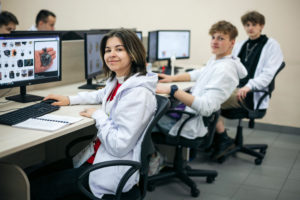
Программа «Веб-дизайн» предполагает:
Intelligent web development is a modern field that combines classic web interface creation technologies with artificial intelligence capabilities.
The «Intelligent Web Development» program includes:
- learning the basics of web development (HTML, CSS, JavaScript) and AI interface design;
- mastering the principles of integrating artificial intelligence technologies into web applications;
- gaining practical experience with AI-API and services for creating intelligent features: smart forms, recommendation systems, and adaptive interfaces;
- design and development of dynamic web applications that interact with AI services, adapt to the user, predict needs, and personalize content.
Curators of the program:
Sitsko Vladimir Aleksandrovich – Senior Lecturer of the Department of Information Systems and Technologies of the Separate Unit «Institute of Information Technologies of BSUIR» of the Educational Institution «Belarusian State University of Informatics and Radioelectronics», Master of Technical Sciences;
Andreychuk Olga Nikolaevna – teacher of the highest category in the «Information Technology Software» department of the Minsk Radio Engineering College branch of the Belarusian State University of Informatics and Radioelectronics, a Master of Technical Sciences;
Irina Aleksandrovna Sereda – Senior Lecturer of the Department of Information Systems and Technologies of the separate unit «Institute of Information Technologies of BSUIR» of the Educational Institution «Belarusian State University of Informatics and Radioelectronics», Master of Technical Sciences.
Designing AI solutions in Python
 Python is one of the fastest growing and most in—demand programming languages in the world. Python is a universal tool: you can use it to create websites, analyze data, automate tasks, and work in the field of artificial intelligence.
The program «Designing AI solutions in Python» assumes:
- learning the basic concepts, features, syntax, and data structures of Python;
- mastering the basics of object–oriented programming (OOP) and working with the Git version control system;
- gain practical experience working with the Requests module, BeautifulSoup, telebot, and aiogram libraries;
- mastering the principles of integrating artificial intelligence technologies in Python applications;
- exploring microservices for creating AI interfaces in Python.
Curators of the program:
Andreychuk Olga Nikolaevna – teacher of the cyclical commission «Information Technology Software» of the educational institution «Belarusian State University of Informatics and Radioelectronics» of the branch «Minsk Radio Engineering College», Master of Technical Sciences;
Irina Aleksandrovna Sereda – Senior Lecturer of the Department of Information Systems and Technologies of the Separate Unit «Institute of Information Technologies of BSUIR» of the Educational Institution «Belarusian State University of Informatics and Radioelectronics», Master of Technical Sciences;
Novik Olga Vladimirovna – teacher of the cyclical commission «Software of Information Technologies» of the educational institution «Belarusian State University of Informatics and Radioelectronics» of the branch «Minsk Radio Engineering College», Master of Technical Sciences.
Artificial intelligence
Artificial (computer) intelligence is an important area of development in computer science and computer engineering. Research in the field of artificial intelligence aims to create formal models, tools, and methods for designing intelligent computer systems that should have the following features:
- the ability to learn and self-learn,
- high learning rate,
- the absence of restrictions on the knowledge and skills acquired by the system,
- the ability to solve intellectual problems in the face of incomplete, unreliable, and contradictory data.
The intellectualization of computer systems significantly expands their application in various fields of human activity, from education and healthcare to industry and the social sphere.
The Artificial Intelligence program includes:
- familiarization with the basic concepts, directions, and history of artificial intelligence development;
- study of the architecture and components of intelligent systems (knowledge base, problem solver, and interface);
- studying modern approaches to the development of intelligent systems;
- learning how to work with Linux-based operating systems and containerization tools (Docker);
- mastering the mathematical foundations of intelligent systems: elements of discrete mathematics, set theory, graph theory, and mathematical logic;
- mastering the means of knowledge representation and formalization, and developing knowledge bases;
- learning the basics of machine learning (setting up classification and clustering tasks, data preparation, training and validation of models, and using Python libraries);
- studying RAG (Retrieval-Augmented Generation) technology to create question-and-answer systems;
- mastering the means of developing problem solvers for intelligent systems and organizing logical inference based on production rules;
- studying the principles of designing multimodal and adaptive user interfaces for intelligent systems;
- development of prototypes of intelligent training systems (training systems for mathematics, physics, chemistry, biology, natural and artificial languages), reference systems (guides, reference books), recommendation systems (assistance in choosing a profession, selecting recipes, planning, etc.), systems for supporting people with individual characteristics, modules and components of intelligent systems, and tools for developing intelligent systems.
Curators of the program:
Zotov Nikita Vladimirovich – Assistant of the Department of Intellectual Information Technologies at the Belarusian State University of Informatics and Radioelectronics;
Salnikov Daniil Andreevich – Assistant of the Department of Intellectual Information Technologies of the Educational Institution «Belarusian State University of Informatics and Radioelectronics»;
Ivashenko Valerian Petrovich – Associate Professor at the Department of Intelligent Information Technologies at the Belarusian State University of Informatics and Radioelectronics. He is a Candidate of Technical Sciences and an Associate Professor.
Digital retail
Digital retail is a modern trading model that uses internet technologies not only for online sales, but also for in-depth analysis of customer behavior, personalization of the experience, and automation of business processes using artificial intelligence and machine learning.
The Digital Retail program includes:
- immersion in the full cycle of online store development: from setting up a local server (XAMPP, Open Server) and installing the OpenCart platform to presenting and protecting the finished project;
- mastering key digital trading tools: practical work with product catalogs, setting up payment and delivery systems, search engine optimization (SEO), and web analytics (Google Analytics, Yandex.Metrica);
- studying and applying artificial intelligence and machine learning in retail, including the implementation of chatbots, recommendation systems, and predictive analytics;
- Creating and optimizing your own online store on the OpenCart platform: from design to launch and performance evaluation.
Curators of the program:
Sitsko Vladimir Aleksandrovich – Senior Lecturer of the Department of Information Systems and Technologies of the Separate Unit «Institute of Information Technologies of BSUIR» of the Educational Institution «Belarusian State University of Informatics and Radioelectronics», Master of Technical Sciences;
Anton Ivanovich Paramonov – Head of the Department of Information Systems and Technologies of the separate unit «Institute of Information Technologies of BSUIR» of the educational institution «Belarusian State University of Informatics and Radioelectronics», Candidate of Technical Sciences, Associate Professor;
Kryukova Daria Sergeevna – Lecturer of the Department of Management of the Educational Institution «Belarusian State University of Informatics and Radioelectronics», Master of Information Technologies.
Программы реализуются при содействии Белорусского государственного университета информатики и радиоэлектроники.






 Minsk, Franziska Skaryna street, 25 k 3